

From Amphitheaters to Movie Theaters
A Guide to the Evolution of
Greek Mythology
in Theater
Since its arrival thousands of years ago, ancient Greek mythology continues to inspire playwrights, authors, scriptwriters, and video game writers alike today. Encompassing love, betrayal, and heroism, Greek mythology laid the foundation for theatrical storytelling, which has long captivated audiences throughout the ages.
But how have the fantastical tales of Greek mythology evolved to become such an influential force for creativity and entertainment today?
In this jam-packed article, we embark on a fascinating exploration into the historical context, cultural impacts, and modern resurgence of Greek mythology, to unveil how the universally loved narratives of gods, monsters, and heroes have become deeply rooted in today’s media.
Greek Mythology Narratives

Gods

Monsters

Heroes
Join us as we reveal the remarkable emergence, evolution, and ongoing transformation of Greek mythology.
Tales as Old as Time
A Journey Through Greek Mythology’s History
-greek mythology in theater-
Ancient Greek Theater
550 BC & 220 BC
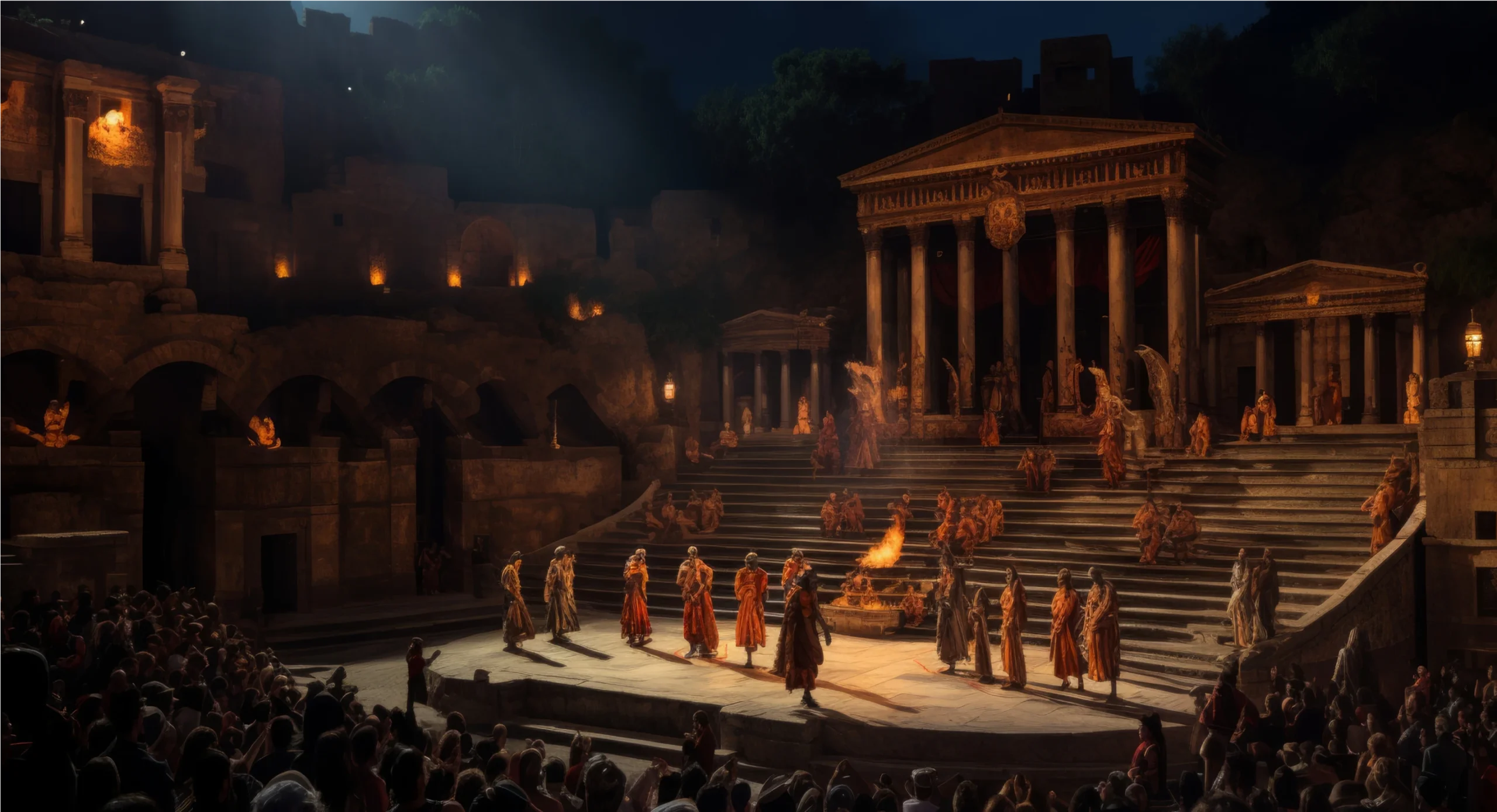
Greek mythology laid its foundations in ancient Greek theater between 550 BC and 220 BC. During this period, Ancient Greece developed a thriving culture that celebrated the wonders of the dramatic arts as an integral aspect of daily life and societal expression.
Dionysus – The God of Wine & Fertility
As Greek theater gained momentum, playwrights emerged with entertaining adaptations of ancient mythological tales. These stories took center stage at religious festivals honoring Dionysus, the god of wine and fertility, where theatrical creativity, culture, and experimentation began to flourish.
This section will explore how mythology became the primary source of inspiration for ancient Greek playwrights while showcasing the most famous writers and plays that emerged during the earlier stages of Greek theater.
You’ll also discover the elements that define Greek theater, and the cultural and religious movement driven by celebration and the worship of gods like Dionysus.
Step back in time and unravel the fascinating history of these ancient arts…
How Greek Mythology Evolved
Into Ancient Greek Theater
-greek mythology in theater-

Dithyramb
/ˈdɪθɪram(b)/
noun
Before there was Greek theater, there was the dithyramb. This was a religious hymn sung by ancient Greeks, specifically boys and men, in honor of Dionysus, the Greek god of wine and fertility.
The First Ever Genre ‘Tragedy’
As time went on, the dithyramb became more animated and dramatic, and chorus leaders, also known as coryphaeus, started experimenting with dialogue. It was during this pivotal moment that narrative storytelling first set foot into ancient Greek culture, and the first ever genre ‘tragedy’ was born.
THESPIS
First Actor In Greek Theater
Many argue that Thespis, an influential poet and the believed first actor in Greek theater, invented the concept of tragedy. His creation of the genre later inspired hundreds of playwrights and influenced generations, leading to further development of Greek theater.

As Greek theater became more established, the art of playwriting became somewhat competitive. This led to festivals where aspiring writers and actors would perform their plays hoping to gain recognition among judges and audiences, and thus achieving fame.
The Arrival Of Satyr – Comedy
In an effort to stand out among competition, playwrights became more creative and experimented with new ideas and concepts that would get them noticed. This led to the arrival of satyr, a comedic, light-hearted genre that was designed to make crowds laugh.
Once these competitive festivals became more popular, standards became established, leading to the development of dramatic structures, such as three-act storytelling, and the use of prologues, and epilogues, leading to a solid theater infrastructure.
Theatrons

As ancient Greek society became more smitten with Greek theater, they began creating designated spaces where dramatic performances could be enjoyed. These spaces were known as theatrons and were built on large hills to accommodate mass audiences while delivering clear acoustics so spectators could hear actors speak.
Calls for Celebration-
Dionysian Festivals
-greek mythology in theater-
The Dionysia was celebrated in two principal forms: the Rural Dionysia, which occurred in winter and was more localized to rural areas, and the City Dionysia, a grand spring festival that attracted participants and spectators from across Greece.
Celebration in Athens
As mentioned earlier, the growing demand for Greek theater combined with increasing competition, paved the way for festivals which celebrated the dramatic arts. The most famous of these festivals was the Dionysia which took place in Athens and other surrounding Greek cities.
This festive occasion was celebrated in two ways:
1.
Rural Dionysia
Rural Dionysia which was hosted during the winter, often in more local, rural areas,
2.
City Dionysia
City Dionysia which was an extravagant spring event where spectators, actors, and playwrights traveled long and far to attend and take part.
Growth of Grapevines & Production of Wine
Before Greek theater took ancient Greek society by storm, these festivals were focused on the growth of grapevines and production of wine, and commonly included parades, sacrifices, and the singing of dithyrambs (the choral hymns sung and danced in honor of the god Dionysus).
Famous Greek Mythology
Playwrights & Plays
-greek mythology in theater-
While many talented playwrights were born out of Greek theater, three names stand out as pioneers of theatrical drama: Aeschylus, Sophocles, and Euripides. Here’s how each playwright played their part in the development and popularization of Greek theater:
Aeschylus
Aeschylus – ‘Father of Tragedy’
Known for groundbreaking storytelling that ultimately popularized the tragedy genre, Aeschylus has gone down in history as the ‘Father of Tragedy’. He wrote over 70 plays, seven of which still stand as classics of ancient Greek literature.
Aeschylus Wrote
His most famous work is the ‘Oresteia’ trilogy which features three intertwined plays:
‘Oresteia’ Trilogy
one
Agamemnon
This is the first play of the trilogy series. It follows the return of King Agamemnon after the triumphant Trojan War, and his subsequent murder by his evil wife Clytemnestra, who kills Agamemnon out of revenge after he sacrificed their daughter Iphigenia.
two
Choephori
Also called ‘The Libation Bearers’, Choephori is the second story which depicts the arrival of Agamemnon’s son, Orestes, who endured several years of exile. Upon returning, Ostes learns of his father’s death, and seeks vengeance by conspiring to kill his mother Clytemnestra and her lover Aegisthus.
three
The Eumenides
In this final play of the sequence, Orestes is pursued by the ancient goddesses of vengeance, known as the Furies, for murdering his mother Clytemnestra. In an effort to avoid conflict and seek sanctuary from the Furies, Orestes runs to Athena, the goddess of wisdom, who orders a trial to determine Orestes’ fate. The trial gives Orestes a chance for redemption, which marks a new era of justice in ancient Greece.
The themes explored in this collection of plays include fate vs. free will, where characters are faced with their destinies versus their ability to make choices. Hubris (meaning excessive pride) comes to light in the second play when characters take matters into their own hands and go against orders set by the gods, leading to tragic and violent consequences.
In the third play, justice is presented, where Athena seeks to settle disputes fairly with a trial by jury, marking a monumental transition from unruly vengeance to a proper justice system.
These themes not only captivate audiences by making narratives more engaging and entertaining but also resonate with viewers, especially during ancient Greek civilization, where such themes were common parts of everyday life, and still are in some ways today.
Sophocles
Sophocles is renowned for his forward-thinking use of dramatic irony, where his plays would allow audiences to see the bigger picture, while characters did not, allowing for audiences to know a character’s fate before it was made apparent to the characters themselves.
Sophocles Wrote
His masterful use of dramatic irony didn’t just give audiences the upper hand, but also built suspense while deepening the emotional impact of his plays. He wrote an impressive 120+ plays, with seven surviving as timeless classics today. Some of Sophocles most influential works include ‘Oedipus Rex’ and ‘Antigone’.
one
Oedipus Rex
‘Oedipus Rex’ tells the tale of Oedipus who became the king of Thebes and married the queen of Thebes after solving a riddle and successfully battling a sphinx. However, while all seem to be going Oedipus’ way, his fate is waiting round the corner as he’s unknowingly fulfilling a dark prophecy.
Through a series of revelations, Oedipus finds out he is responsible for his father’s murder and his mother’s husband’s, and discovers his wife, the Queen of Thebes, is actually his mother. Horrified, Oedipus rids himself of sight by removing his own eyes before exiling himself from Thebes.
Enriched with themes of fate, free will, and divine prophecy, the story of Oedipus is deeply philosophical, and left a profound mark on the ancient Greeks by encouraging them to reflect upon life’s unpredictable, and arguably predetermined, twists and turns.
two
Antigone
‘Antigone’ is another of Sophocles’ most celebrated works. The story is set in the city of Thebes, where Antigone, the daughter of Jocasta and Oedipus, who goes against Creon’s, the king of Thebes, law and buries her late brother who was killed battling against his city.
This though-provoking play delves into themes of justice, personal morals, and the dangers of pride. The combined themes challenged ancient Greek society’s beliefs and understanding of morality and authority, and believably sparked heated debates that went beyond the stage, leaving Sophocles’ work as impactful as it was entertaining.
Euripides
Euripides is the third of the greatest tragedians, whose works are famed for their boundary-pushing narratives that go beyond the standards of traditional Greek tragedies.
Unlike most of his counterparts, most of Euripides’ plays lead with strong, independent female characters and feature forward-thinking plot structures with complex psychological layers which challenge societal and political issues.
Euripides Wrote
Medea play
Euripides composed around 90 plays, with only 28 remaining completely intact. His most famous surviving play is ‘Medea’ which focuses on the cunning and sorceress wife of Jason named Medea.
Over the course of their romantic relationship, Medea proved her devotion to Jason by helping him get out of sticky situations with her powers. However things turn sour when Jason betrays Medea and leaves her for another woman,the princess of Corinth.
Enraged and heartbroken, Medea goes to disturbing lengths to seek revenge by murdering their children with the intention of taking Jason’s heirs away and leaving him to mourn the death of his children.
This play is fueled by provocative themes of loyalty, betrayal, and vengeance, while also pushing the traditions of ancient Greek theater through its boldand unfiltered portrayal of a female protagonist who takes matters into her own hands.
The Structural Elements of Greek Mythological Plays
-greek mythology in theater-
There are several structural elements that define ancient Greek mythological plays, each playing a key role in distinguishing different types of storytelling and dictating how audiences experience theater. Let’s take a closer look…
Greek Tragedies
-greek mythology in theater-
Greek tragedies have a unique set of storytelling features and performance elements which combine to captivate audiences, divulge key themes (such as fate and retribution), and deliver emotional depth. Here’s a breakdown of what each structural element entails:
Prologue
This first stage introduces the foundations of a narrative, providing audiences with contextual background about the story. This is either done through a spoken monologue or dialogue that sets the scene, introduces characters, and highlights the major conflict or dilemma that carries the narrative.

Parodos
This is when the chorus announce their arrival on stage by performing an entrance song or chant, often in the form of a poem. Aside from marking the arrival of the chorus, the parados is also intended to set the mood for the play, offering audiences with background information to further illustrate the setting and communicate the context of the story, and highlight key themes.
Episodes/Scenes
The episodes or scenes are the body of the tragedy where the drama unfolds and the plot develops. Throughout each episode, actors will perform spoken dialogue and actions which often present conflicts, pivotal decisions, and revelations in the storyline. Because it’s a tragedy, the character’s actions often lead up to a hero’s downfall.
Stasimon (Choral Odes):
This interlude serves as a summary of the episodic events that have unfolded. During this part of the play, the chorus performs a choral ode which reflects upon the events so far, while exploring broader themes and even offering moral guidance to audiences.
Exodos
This is the final stage of the play, when the story is wrapped up. During this point, remaining conflicts are resolved and the consequences of the characters’ actions surface, leading to the ultimate fate or resolution. Final speeches or monologues are a common custom, where characters reflect on the events that unfolded throughout the story. Last farewells and parting words are also exchanged between characters before the chorus delivers closing remarks, pointing out moral lessons and summarizing key themes of the play, leaving audiences with food for thought. Musicians may also perform exit music to close the play.
Greek Comedies
-greek mythology in theater-
Greek comedies follow a very similar structure to tragedies, but rather than portraying serious tones throughout each phase, they employ lighter, humorous themes and satire to entertain audiences. Here’s how each element in Greek comedy differs from tragedy:
Prologue
Just like tragedy plays, the prologue of ancient Greek comedies sets the scene, introduces characters, provides context to the story, and lays out the initial situation or conflict. The overall purpose of prologues in Greek comedies isn’t to simply convey the premise for audiences, but also set the stage for comedic elements that will later arise.
Parodos
This is when the chorus enters the stage, often wearing outlandish, caricature costumes for comedic effect. They sing amusing songs with playful lyrics that mock societal norms, public figures, and introduce key themes of the narrative.
Agon
A unique element of Greek comedy where the main conflict or debate is portrayed between characters through witty arguments and satire. During this stage, characters will engage in back-and-forth verbal sparring, often using clever wordplay and humor to mock societal norms and amuse audiences.
Parabasis
This is another unique feature of Greek comedy, where the chorus breaks the fourth wall and directly addresses the audience. Similarly to the stasimon, or choral odes, in Greek tragedy, the parabasis steps aside from the narrative, providing audiences with commentary and reiteration of key themes and satirical elements. It also traditionally includes the playwright’s personal opinions and criticisms of contemporary Athens.
Episodes/scenes
As seen in Greek tragedy, this part divides the play into episodes, or scenes, where action enriched with humor and satire is performed, unfolding the plot and moving the story forward.
Exodos
This is the concluding part of the comedy, where any remaining conflicts are resolved and victory of the protagonist is celebrated. An exit song is custom, closing the play off and leaving audiences with themes to reflect on, such as triumph or the importance of humor.

The Role of the Chorus
-greek mythology in theater-
Tragedy & Comedy Plays
As you probably noticed from exploring the structure of Greek theater, the chorus plays a key role in both tragedy and comedy plays. They provide both narrative background to get audiences on-board with the story and deliver commentary throughout performances to bridge scenes.
CHORUS IN TRAGEDIES & COMEDIES
TRAGEDIES
In tragedies, it’s more common for the chorus to offer insights into important themes, ensuring audiences understand the moral lessons being conveyed. They also emphasize the weight of unfolding tragic events, creating more of an emotional impact on audiences and provoking reactions.
COMEDIES
On the other end of the scale, a comedy chorus will deliver comedic relief through humorous songs, witty commentary, banter and animated dances. They also deliver a commentary on major events within the play, with the aim of enhancing the satire that mocks societal norms.
It’s also common practice for a comedy chorus to directly speak to audiences, delivering jokes, and satirical dialogue that adds to the humorous and lighthearted atmosphere experienced by the audience.
The Many Faces of the Chorus
The Costumes & Masks That Brought Myths To Life
Beyond their verbal queues, the chorus also wore elaborate costumes and masks that delivered an immersive visual aid for audiences, ultimately bringing myths to life. They helped distinguish different characters, while creating a symbolic representation of characters’ roles, traits, and affiliations.
For example, in tragedies, the chorus would typically wear dark robes and masks with sad or angry expressions to convey the tragic themes of a play and foster a dismal tone. In comedies, vibrant attire would be flaunted and comical masks with animated expressions would be worn, contributing to a festive and humorous atmosphere.
Fantastical Themes Within Greek Mythology
-greek mythology in theater-
There’s a variety of inescapable themes that lie within ancient Greek mythological plays. From destiny, revenge, and mortality to social satire, every theme in ancient Greek theater reflects the cultural values of the ancient Greeks, regardless of whether it’s a somber tragedy or a lighthearted comedy. Here’s an overview of the major themes in Greek theater…
Common Greek Tragedy Themes
-greek mythology in theater-
Fate and Destiny
This theme is often grounded in ancient Greek religious beliefs that gods dictate each mortal human’s life, creating predestined pathways that can’t be changed. It explores how fate can shape one’s experiences, opportunities, and overall existence.
Hubris and Pride
This theme reveals the tragic consequences of excessive pride and arrogance, serving as a caution that shows audiences what might happen if they defy the gods, and the risks of letting one’s ego dictate their actions.
Moral Ambiguity
This philosophical theme examines complex ethical dilemmas that were often faced by ancient Greek society, while also highlighting the ambiguity of right and wrong. It was often included by playwrights who wanted to create a cathartic release that left audiences emotional and reflective of moral questions and the complexities of human nature, long after watching a play.

Popular Themes Within Greek
Comedies
-greek mythology in theater-
Satire & Social Commentary
In an effort to humorously mock societal norms, Greek comedies would use satirical wit through humor and excessive exaggeration. This allowed audiences to relate to common problems and laugh at the customs and norms of ancient Greek society.
Miscommunication & Irony
These themes combined to highlight how messy human interactions can be, especially when assumptions are made and actions are misunderstood. While such themes would otherwise end in turmoil and chaos in tragedy plays, miscommunication and irony open doors for comedic twists in comedy drama.
Celebration Of Festivity & Mirth
These themes emphasize joy and festivities. It was widely loved by ancient Greek audiences as it provided a lighthearted form of entertainment while delivering escapism, happiness, and endless laughter.
Echoes of Olympus
How Greek Theater Influenced Roman Stages
-greek mythology in theater-
It didn’t take long before the Greek’s unique dramatic arts gained the attention of the Romans. As Ancient Rome saw a revival of classical texts, they started seeking new ways to dramatize these age-old stories, and turned to the Greeks for inspiration. This led to an exploration of mythical creatures, new types of characters, such as nymphs.
Art Comedy
However, the Romans loved doing things their way, so rather than directly adopting the structural and thematic elements of Greek drama, they put their own spin on things. A key example of this includes the commedia dell’arte, which translates to ‘art comedy’.
Unlike Greek comedies which followed a traditional structure and script, the Romanized version was improvised, focusing on stock characters that occasionally drew upon Greek mythological motifs.
Roman playwrights, including the famous Plautus, Terence, and Seneca, based their works on ancient Greek tales.
They translated and adapted Greek tragedies and comedies, incorporating societal elements and themes of Roman life, such as honor, duty, and piety, to ensure plays reflected Roman society and resonated with audiences. Despite tweaking certain areas, Roman plays still drew from core Greek mythological themes and narratives, including fate, hubris, and the complexities of human nature.
Roman Gods & Heroes
-greek mythology in theater-
Roman plays featured gods and mythical heroes from Greek mythology, but with a slight twist. They often referenced such characters and figures under alternative Roman names. Here are some of the most famous Roman gods taken from Greek mythology
Jupiter (Zeus)
Known as the king of the gods, ruler of the heavens, and wielder of thunderbolts in both Greek and Roman mythology, Jupiter (aka Zeus) is the most powerful god of them all.
Neptune (Poseidon)
Neptune is the god of the sea, earthquakes, and horses, much like to the Greek deity Poseidon.
Mars (Ares)
Parallel to the Greek god Ares, Mars is the god of war and violence, serving as a symbol of the brutal and destructive nature of warfare.
Venus (Aphrodite)
Venus, the goddess of love, beauty, and fertility, is just like the Greek goddess Aphrodite. She was worshiped for her powers that inspired passion and desire, making her the center point of many romantic relationships and plots in Roman theater.
Mercury (Hermes)
Similarly to Hermes, the Greek god of communication, travel, trade, and luck, who served as a guide for mortals, Mercury, served as a messenger that escorted souls to the underworld, and was associated with trade, communication, and travel.

Each of these deities and heroes played colossal roles in Roman narratives, serving as avenues for exploring human nature, morality, and the relationship between mortals and gods.
Roman Theater Design
-greek mythology in theater-
The Romans adopted the Greek architectural design of theaters, including the semi-circular orchestra, the skene (stage), and the tiered seating arrangement. However, Roman theaters were often built as freestanding structures, unlike the Greek theaters that were typically built into hillsides.
Not only did the Romans adopt Greek mythology, they also based their theater design on the ancient Greeks. Elements including a semi-circular orchestra, skene (aka stage), and tiered seating layouts for audiences were all borrowed from traditional Greek theater architecture.
Theater of Pompey

However, there were some differences that set Roman theater structures aside from Greek theater. For example, the Romans built their theaters as freestanding structures in city centers, as seen with the beautiful Theater of Pompey in Rome, whereas the ancient Greeks built their upon hillsides.
Roman Costumes & Mask Designs
Roman inspiration from Greek theater went beyond ancient Greek theater infrastructures. They even embraced similar costume and mask designs.
Just like in Greek theater, Roman performance masks were crafted to reflect the characters’ roles and emotions, and were designed for quick changes in between roles, allowing the same actor to perform different parts in the same play.
Cultural & Social Adaptations
-greek mythology in theater-
The Romans were a bit more direct when it came to political and social commentary in theater, when compared to their Greek counterparts. They harnessed plays as more of a political propaganda, rather than a simple form of entertainment for audiences, which is reflective of how strict and valued Ancient Roman political forces were.
However, this doesn’t mean they didn’t have any fun! The Romans still enjoyed a plot-twist and a laugh, so many aspects of Roman theater incorporated tragedy, drama, farce, and satire.
Their profound love for such elements laid the ground for new and original genres,
Fabula Palliata
a type of Roman comedy that drew from the concept of Greek ‘new’ comedy
Fabula Crepidata
Roman tragedy that diverged from traditional Greek tragedy.
In keeping with the Roman’s notorious love for spectacle, they would supplement plays with elaborate machinery (such as revolving stages), innovative stagecraft (like trapdoors and pulley systems), and even action-packed combat, creating an unforgettably dramatic performance.
The Grand Revival of Greek Myths during the Renaissance Era
-greek mythology in theater-
The Renaissance
The Renaissance was an era marked by cultural movement, where the arts, including literature, painting, and theater, sparked a new wave of creativity. During this time, European theater experienced a huge revival of Greek mythology, where writers and artists alike used these magnificent tales to inspire their own works.
A New Wave of Creativity In

Literature

Painting

Theater
Renaissance playwrights & poets
Renaissance playwrights and poets, such as William Shakespeare and Christopher Marlowe, adopted elements of Greek mythology to explore new themes of love, power, revenge, and redemption. These stories allowed artists to express their views and arguments surrounding political and social issues during the Renaissance period.
Humanism & Mythological
Themes
-greek mythology in theater-
Humanism was the backbone of the Renaissance spirit. It was a movement that was fixated on the shared human experience.
Because ancient Greek mythology heavily focused on themes surrounding human existence, virtues, and flaws, humanist artists and scholars deeply resonated with ancient Greek tales.
This provoked them to create their own stories that depicted their own views and feelings about fate, free will, morality, and the pursuit of beauty, mirroring common themes found in Greek theater.
Seneca’s ‘Octavia’
For example, ‘Ecerinis’ by Latin playwright Albertino Mussato is heavily inspired by Seneca’s ‘Octavia’ featuring parallel themes, such as power struggles, revenge, and the inherent complications of human nature.
Modern Adaptations of Greek Mythology
-greek mythology in theater-
Throughout modern art and media, there are loads of adaptations of Greek mythology that pay homage to these iconic ancient tales.
These adaptations typically reimagine classical myths by setting them in modern society to reflect contemporary issues and perspectives that today’s audiences can relate to, much like how the Romans altered their plays to resonate with Roman society!
Here are some popular examples of how contemporary artists, writers, and directors have inspired their works from Greek mythology to create modern, relatable, and captivating entertainment:
In Theater
-greek mythology in theater-
Hadestown
There are many magnificent modern theater plays inspired by the marvels and mysteries of Greek mythology. Broadway play ‘Hadestown’ by Anaïs Mitchell is a Tony-award-winning musical that intertwines many familiar myths, including the tale of Orpheus and Eurydice, with a unique contemporary twist.
It’s set in a disastrous post-apocalyptic, depression era reimagining of the underworld, where a starving, poverty-stricken young girl goes to work, resulting in her lover, Orpheus, on a mission to rescue her from the terrifying hellish depths.
The Penelopiad
Margaret Atwood’s ‘The Penelopiad’ is another critically acclaimed contemporary play that’s derived from ancient Greek mythology. This story focuses on Penelope, the daughter of King Icarius and mother of Odysseus’s wife, Telemachus, who finds herself reminiscing about past events, including her life in Hades and relationships with her parents.
In Literature
-greek mythology in theater-
There are hundreds of gripping modern literature works with mythological plots and themes.
Madeline Miller’s – ‘Circe’
Madeline Miller’s best-selling fantasy novel ‘Circe’ is among the fantastic contemporary books inspired by ancient Greek tales. This novel reimagines the life of Circe, the sorceress daughter of sun god Helios and ocean nymph perse, focusing on provoking themes of power, identity, and transformation.
Madeline Miller’s – ‘The Song of Achilles’
“The Song of Achilles” by Madeline Miller is another famous example that retells the triumphant story of Achilles, but rather than being from Achilles’ perspective, it’s from the viewpoint of Achilles’ brother-like friend Patroclus, focusing on their relationship in the lead up to the Trojan War.
In Cinema & Television
-greek mythology in theater-
Ancient Greek mythology has been a key influence in both film and TV.
Percy Jackson and the Olympian
For instance, the hit blockbuster film series ‘Percy Jackson and the Olympian’ by Thor Freudanthal and Chris Columbus tells the story of modern teenage demigods who embark on an action-packed adventure across America, where many ancient Myths come to life, such as Medusa, the Minataur, and the Hydra.
American Gods
Hit TV series ‘American Gods’, based on Neil Gaiman’s best-selling novel, is another example that incorporates many mythologies, including Greek tales of Zeus and Hera. It also explores familiar themes found in Greek theater, including faith, identity, and mortality.
In Video Games
-greek mythology in theater-
Beyond modern theater, literature, film and television, ancient Greek mythology has reached beyond conventional media and entered the realms of video games.
In fact, some of the most successful games have been derived from ancient Greek tales, such as the critically acclaimed game ‘Hades’ which follows Zagreus, the son of Hades, as he tries to defeat the evil creatures that lurk within the Underworld and escape.
‘Assassin’s Creed: Odyssey’ is another top-grossing video game that dives deep into Greek mythology. Set during Peloponnesian War, this action-fuelled role player game (RPG) lets players roam a huge open world that’s home to many mythological beasts, gods, and historical figures, creating a synergy between history and mythology.
Conclusion
The Lasting Legacy of Greek Mythology in Theater, Film, and Television
-greek mythology in theater-
Over the course of more than 2,700 years, Greek mythology has weaved its way into every corner of human culture. From grand amphitheater performances during ancient Greece to modern films, television, and video game plots centered around gods, monsters, and epic quests, the legacy of Greek mythology has left an eternal mark on storytelling.
Weaving into Human Culture

While some love mythology for its political, religious, and philosophical symbolism, others are amused by its thrilling action and adventure-packed narratives. Nonetheless, regardless of why people enjoy Greek mythology, it’s safe to say that everyone is captivated by the timeless tales of ancient Greek mythology that transcend generations, worldwide culture, and beliefs.